
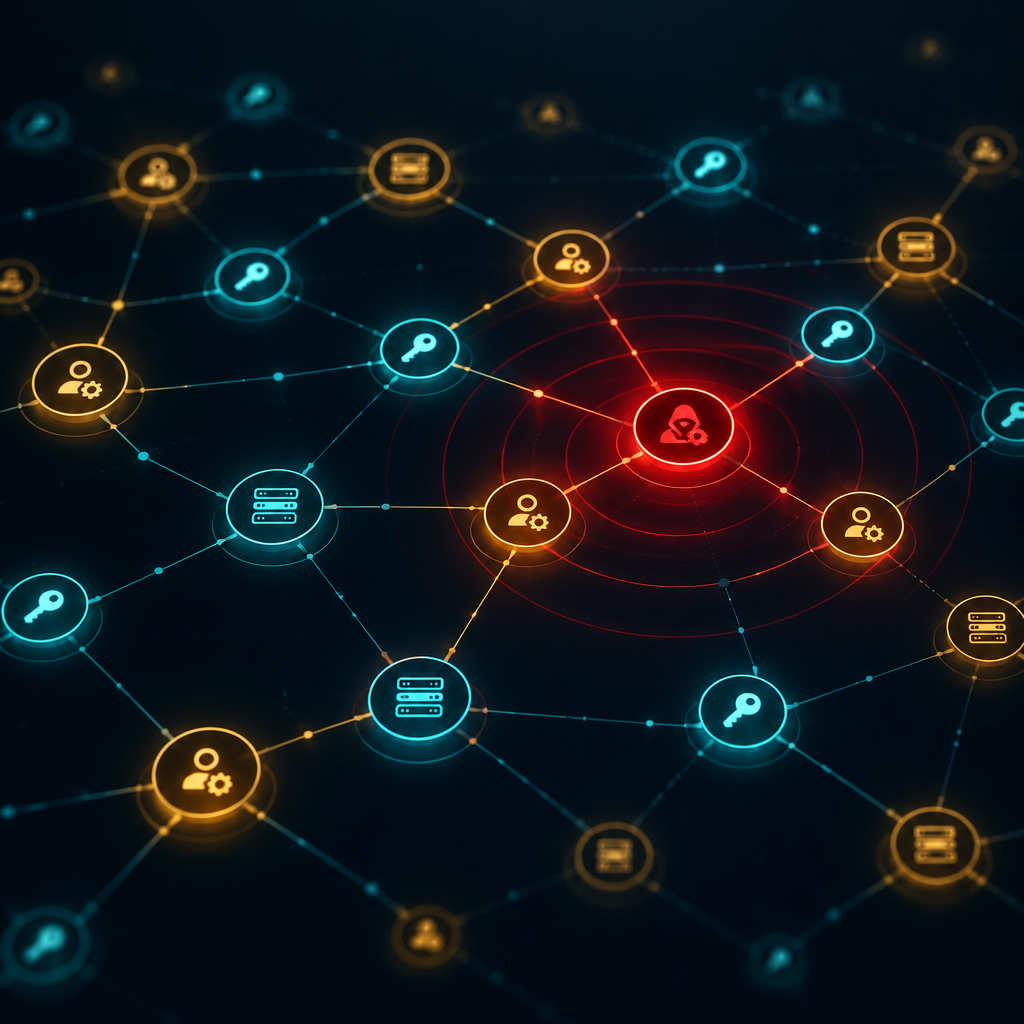
Incident response has spent two decades rehearsing for a human attacker who breaks in, moves laterally, and exfiltrates data. The playbooks, the tabletop exercises, the escalation trees: all of it assumes a threat actor operating through accounts that belong to people. Machine identity quietly breaks that assumption. When the compromised credential is a service account, a CI/CD token, an OAuth app, or an AI agent’s delegated grant, the familiar questions of who was affected and what they touched stop having clean answers.
Why standard playbooks stall
The first problem is ownership. A human account has a manager, a department, and an HR record. A non-human identity often has none of those things. It was created by an engineer who has since changed teams, it is referenced by three applications, and its purpose is documented nowhere. When an analyst opens a ticket at 2am, the containment decision depends on knowing what breaks if the credential is revoked. In most organisations, nobody can answer that within the window the incident demands.
The second problem is detection. Machine credentials rarely announce themselves. A stolen token used from a new geography looks like a deployment pipeline running from a new cloud region. Behavioural baselines built for human working hours misread machine activity, which is continuous, repetitive, and often high-volume by design.
The third is scale. A single compromised secrets store can expose thousands of identities at once. Revoking them one by one is not an incident response, it is a maintenance project.
What a machine-aware playbook contains
Organisations that handle these events well tend to build the same four elements.
An inventory that survives contact with reality
You cannot contain what you cannot enumerate. Effective teams maintain a continuously refreshed register of non-human identities with owner attribution, environment, privilege level, and last-used data. The register is the difference between a fifteen-minute containment and a fifteen-hour one.
Pre-agreed blast radius decisions
Rather than debating whether to revoke a credential mid-incident, mature teams decide in advance which classes of identity can be cut immediately, which require application owner sign-off, and which need a staged rotation. That decision matrix is the core of the playbook and it belongs in peacetime, not in the war room.
Rotation as a rehearsed capability
Automated rotation is only useful if it has been tested under load. Teams should run scheduled drills that rotate a production credential end to end, including every dependent service, and measure the time to full recovery. The number that matters is not how fast the secret changes but how long until the business function is restored.
Evidence trails that satisfy auditors later
Machine identity incidents frequently end in a regulatory or contractual conversation about scope. Logging every credential use, every policy decision, and every revocation against a stable identity record turns a painful investigation into a query.
The governance layer underneath
Playbooks are downstream of architecture. Organisations that treat machine identity as a lifecycle problem, with issuance, ownership, monitoring, and decommissioning handled by a control plane rather than by individual teams, find that incident response becomes a matter of executing known steps against known assets. Those that treat it as a secrets management side quest discover, during the incident, that they have been running an unmanaged estate.
The uncomfortable truth is that most machine identity breaches are not sophisticated. They exploit credentials that were over-privileged, never rotated, and owned by nobody. A playbook that surfaces those three facts quickly is worth more than any amount of post-incident analysis.