
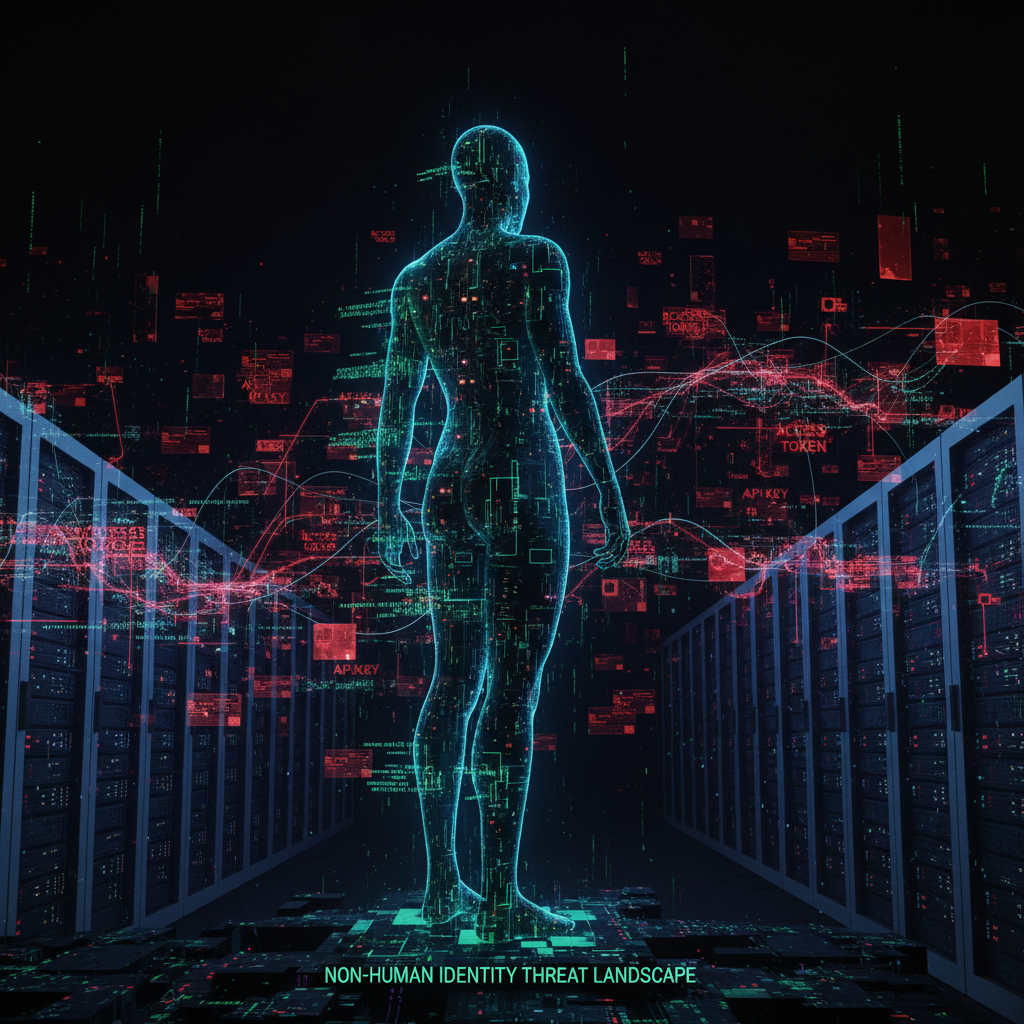
Traditional attackers need time. They conduct reconnaissance, map network topology, enumerate user accounts and group memberships, identify privilege escalation paths. These reconnaissance phases leave traces—logs, alerts, behavioral anomalies that security teams can detect.
AI agents operating under legitimate credentials have a superpower: they can enumerate everything as part of normal business operations. A machine learning model requests a list of all files in a data lake. An infrastructure automation agent queries cloud APIs for account inventories. An analytics pipeline pulls user and group data for processing. To a traditional security stack, these look like normal operations. In reality, they’re perfect reconnaissance for a lateral movement attack.
The problem intensifies when the AI agent is compromised, confused (by prompt injection attacks), or maliciously instructed. An attacker with control of a legitimate service account can pivot far more effectively than a traditional lateral movement campaign. The agent has inherent trust. It has legitimate credentials. It can make API calls that return full responses without triggering alerts. It can traverse permission boundaries at machine speed, identifying weaknesses and escalation paths faster than any human attacker could.
This creates an asymmetric security problem. Traditional IAM and PAM tools focus on detecting humans doing human-like malicious things. They watch for abnormal login patterns, impossible travel, bulk data downloads. But an AI agent operating under compromised credentials might not trigger any of these alerts. It’s following its programmed behavior. It’s using credentials that are supposed to be legitimate. From the perspective of legacy security tools, everything looks normal.
Enterprises addressing this challenge are implementing agent-specific behavioral analytics. Rather than looking for human indicators of compromise, they’re establishing baselines for what each agent should be able to do—which APIs it should call, which data sources it should access, what its normal query patterns look like. When an agent deviates from its baseline, alerts fire. When permissions it shouldn’t have are suddenly used, the system responds immediately.
Some organizations are taking this further, implementing segmentation policies that limit what any single non-human identity can enumerate or access, even under normal conditions. Rather than giving an agent broad access with the assumption that it won’t misuse it, they’re implementing granular service-to-service authorization models where each agent can only interact with the specific resources required for its function.
The vendors innovating fastest in this space are building threat detection specifically for agentic behavior. The security implications are significant: as AI agents become more prevalent in enterprise operations, the reconnaissance and lateral movement phases of attacks are being fundamentally redefined.