
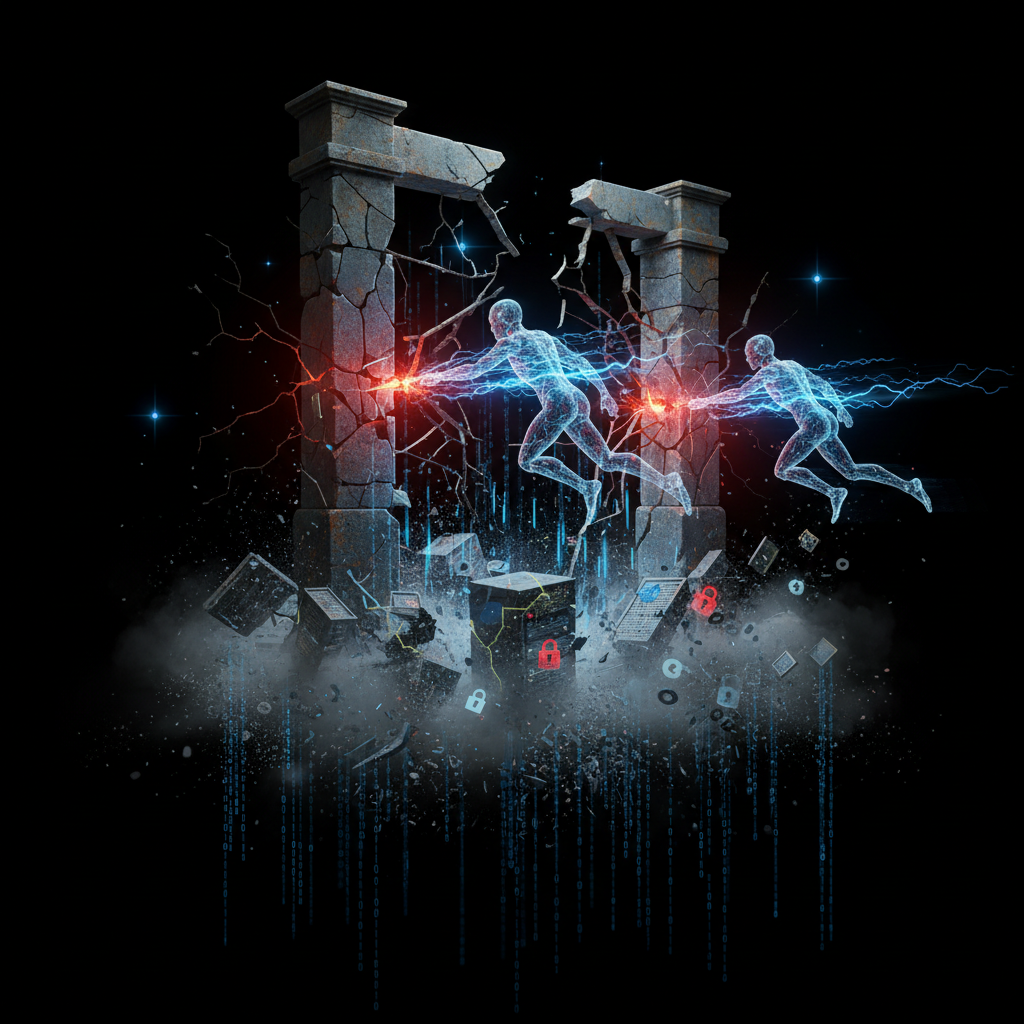
Traditional Identity and Access Management systems were built for a predictable, human-operated world. They assume authentication happens once, authorization is static, and audit trails track human decisions. But the rapid deployment of AI agents into enterprise environments is exposing a fundamental architectural mismatch — legacy IAM cannot keep pace with machine identity at scale.
AI agents operate at machine speed, making thousands of API calls, spinning up ephemeral workloads, and requesting permissions in patterns no human could predict or audit manually. The IAM stack built for humans — with its assumption of periodic, visible authentication events and reliance on human-readable identity stores — crumbles under this new operational reality. A single AI agent orchestrating a multi-step workflow can generate more identity-relevant events in seconds than a human user generates in a month.
The Velocity Problem
At the heart of this crisis is velocity. Human-centric IAM assumes a certain cadence: a user logs in, a manager approves a role change, an audit is conducted quarterly. Non-human identity operates at millisecond granularity. An AI agent requesting database credentials needs an answer in microseconds, not the minutes a traditional MFA challenge requires. This timing mismatch means either security controls are bypassed or agents fail to complete their work — forcing teams into impossible choices.
Credential Sprawl Without Governance
Without purpose-built machine identity controls, each AI agent deployment creates new shadow credentials: API keys scattered across CI/CD pipelines, hardcoded service account passwords in source code, temporary tokens that expire but are never revoked. This is not a scaling problem — it is a fundamental governance failure. Traditional role-based access control (RBAC) cannot express the granular, time-bound, purpose-specific permissions that agentic workloads require. A machine identity needs to say: “I can read this database table, but only to execute query X, only during this scheduled window, and only when initiated by process Y.” Legacy RBAC offers none of these guardrails.
The Visibility Blind Spot
A human-focused audit trail assumes human actors. It tracks login events, permission grants, policy changes — all legible to human eyes. But when an AI agent acts, it generates machine-scale telemetry: millions of API calls, transient identity tokens, rapid-fire service-to-service interactions. Most SIEM and logging systems were not designed to ingest this volume and surface the signal — the human operators managing these systems are blind to most of what their AI agents are doing.
Machine Identity Security Requires New Primitives
Solving this requires IAM teams to embrace machine identity as a distinct security domain with its own governance model. This means moving beyond username/password and certificates to include short-lived identity tokens, cryptographic proof of workload identity, and policy engines that can express intent at machine speed. It means building zero-trust for service-to-service interactions, where every interaction must be authenticated and the policy decision rendered in milliseconds. It means investing in visibility layers that can normalize and correlate machine identity telemetry without requiring human interpretation of every event.
Organizations deploying AI agents without rearchitecting their identity governance layer are building on sand. The IAM stack was never meant for this scale of machine-generated activity, and patching human-centric systems with point solutions will not close the gap. As AI agents become endemic to enterprise operations, machine identity becomes the new frontier of cybersecurity.
Source: Solutions Review