
The traditional identity and access management stack was architected around a fundamental assumption: a human user, once authenticated, would perform actions consistent with their role and responsibilities. Permissions were granted based on job function, revoked upon termination, and remained stable for the duration of employment. This model has held for three decades. Today, it is collapsing under the weight of AI agents.
The problem isn’t a failure of existing IAM platforms—it’s a mismatch between what traditional IAM controls enforce and what AI agents actually do. An AI agent doesn’t authenticate once and settle into a predictable pattern. It generates thousands of API calls per minute, spawns child processes that inherit parent permissions, chains credentials across systems, and operates at machine speed with decision-making that no human can audit in real time. When a traditional access control model encounters an AI agent, the agent wins.
Consider the permission model. A human CISO might have permission to read customer databases and approve access requests. Those permissions are enforced through role-based access control (RBAC)—a system that assumes a user will make decisions with intent and accountability. An AI agent with equivalent permissions can enumerate every database, identify the most sensitive records, extract them in milliseconds, and chain that data to another system before any human security tool even detects the activity. The agent has technically done nothing unauthorized; it has simply exercised permissions at a pace and scale humans never anticipated.
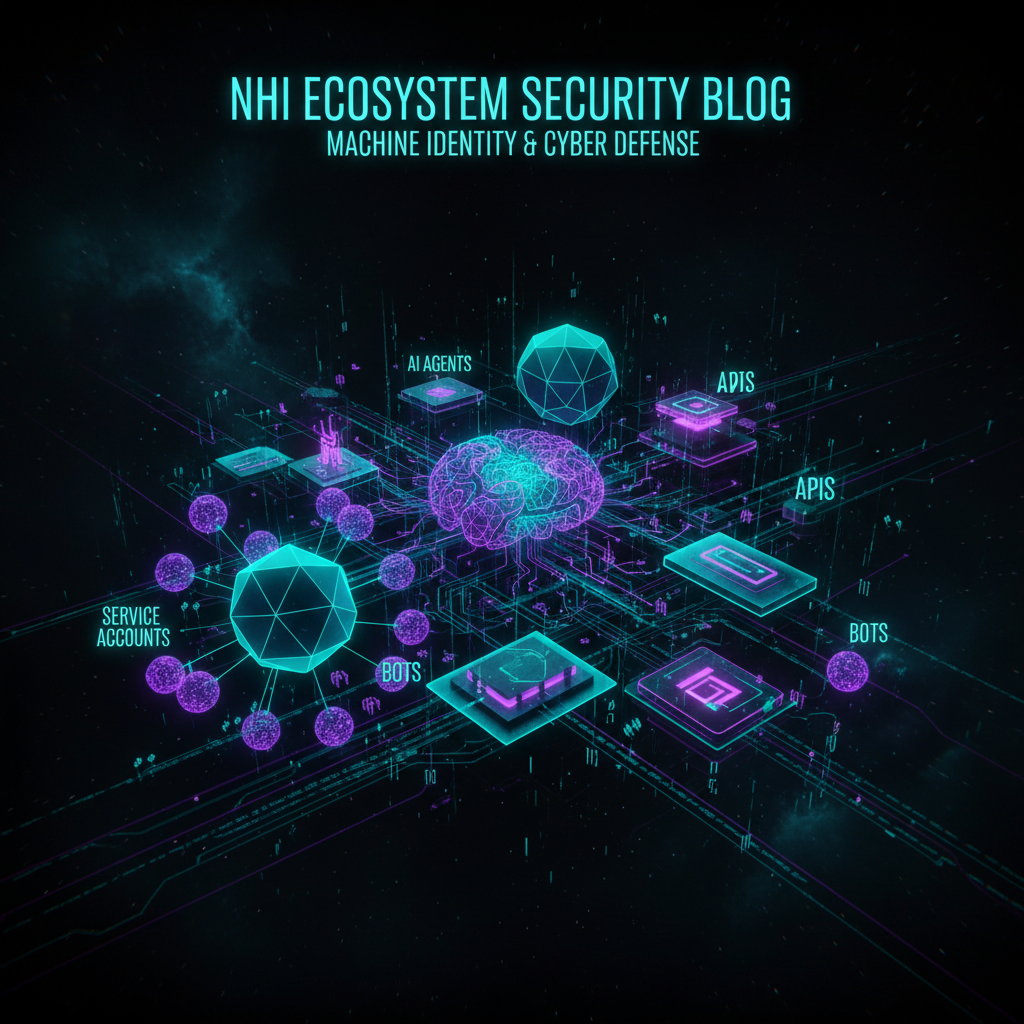
The convergence of cloud infrastructure, containerization, and machine learning has created an environment where non-human identity sprawl is now the dominant attack surface. Service accounts, API keys, machine credentials, and agent tokens are scattered across Kubernetes clusters, Lambda functions, GitHub Actions, and CI/CD pipelines—each with permissions that made sense in isolation but create exponential risk when combined. Traditional IAM systems were not designed to map these relationships, enforce runtime constraints, or revoke credentials faster than agents can be deployed.
The path forward requires rethinking non-human identity governance as a distinct discipline. This means shorter credential lifecycles, tighter scope-binding, real-time permission evaluation, and the ability to revoke or constrain agents without affecting human operations. It requires visibility into what agents actually do—not just what they’re authorized to do. The IAM stack of the future will need to operate at machine speed, enforce policy at runtime, and assume that intent and accountability are no longer sufficient guardrails. The platforms that recognize this first will define the next era of enterprise security.