
As AI agents become embedded in critical business workflows, organizations face a fundamental identity crisis. Traditional approaches to service accounts and machine identity were designed for static, long-lived workloads with predictable permission requirements. AI agents operate under entirely different constraints: they need temporary, context-specific access; they make decisions that trigger cascading permission requirements; and they often run in distributed, cloud-native environments where traditional perimeter security is obsolete.
The crisis is not just technical—it’s architectural. Most enterprises lack the infrastructure to answer a basic question: “Who is this agent, and should it really be doing that?” Without robust agentic identity frameworks, organizations deploying AI agents are inadvertently creating shadow IT at machine speed. Agents with over-privileged access. Agents that can’t be audited. Agents that operate outside the visibility of existing security controls.
The Identity-Access-Audit Triad
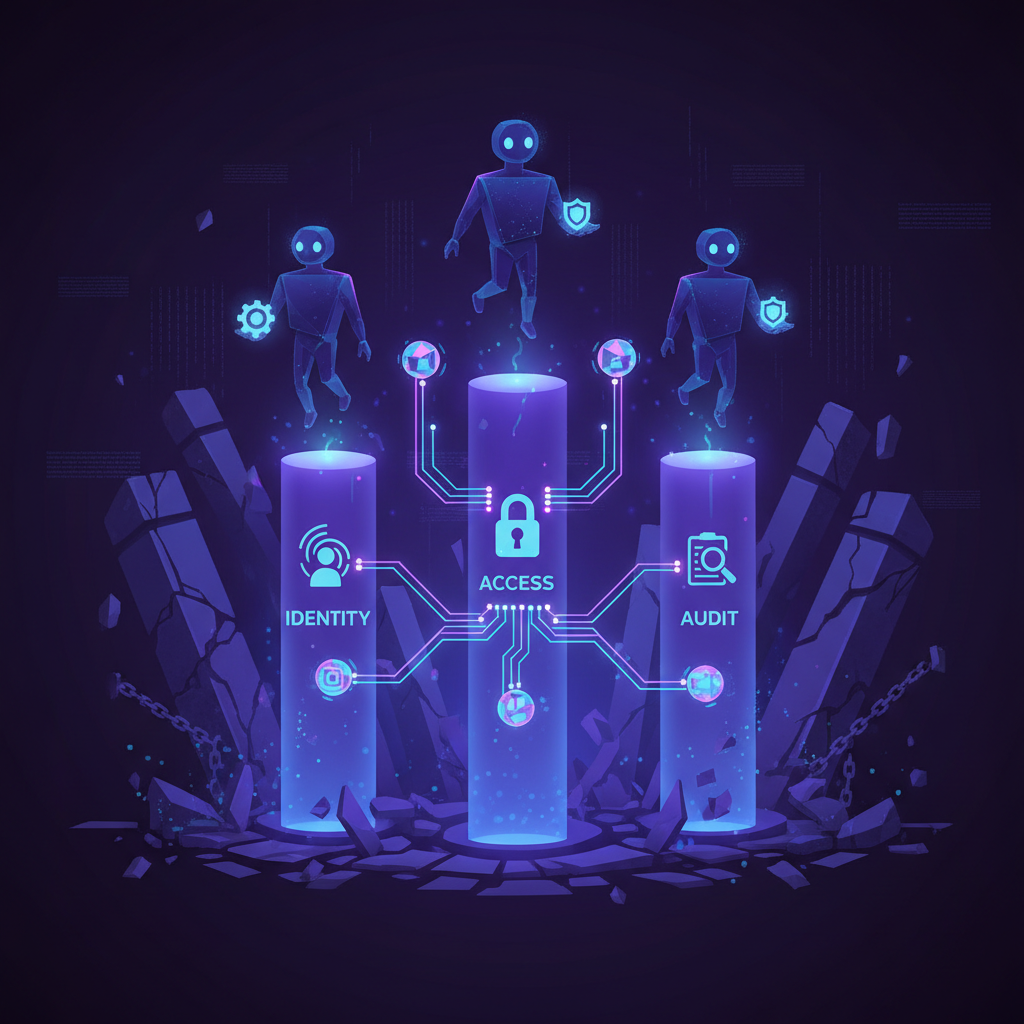
Solving the identity crisis requires addressing three interconnected challenges simultaneously. First, identity must be machine-native—agents need to authenticate in ways that don’t require human interaction and that support continuous trust validation. Second, access control must be dynamic and context-aware. Third, audit trails must capture not just what an agent accessed, but why it requested that access and what problem it was solving.
Most organizations have only one or two of these pieces. They have machine identity provisioning but no context-aware access. They have access controls but can’t trace audit events back to the agent’s decision logic. Solving the identity crisis means building a unified framework where all three components work together. An agent’s identity becomes meaningful only when paired with fine-grained access decisions and comprehensive audit trails.
Why Traditional IAM Fails Agentic Workloads
Legacy IAM systems make assumptions that don’t hold for AI agents. They assume permissions are granted to static principals (users or service accounts) with stable roles. They assume access is requested by sentient beings who can be held accountable for their actions. They assume change is infrequent enough to be managed through quarterly reviews.
AI agents break all three assumptions. An agent might request different permissions for different tasks. An agent running in a container might have a different identity every time it spins up. An agent might delegate work to other agents, creating chains of trust that traditional role-based access control cannot represent. Until IAM evolved to handle these patterns, the “crisis” is inevitable.
Building Non-Human Identity That Actually Works
Forward-thinking security teams are solving the crisis by building identity platforms that treat agents as first-class citizens. This means implementing agent identity at the orchestration level (where agents are spawned and configured), not just at the infrastructure level. It means defining machine identity policies that account for agent behavior and decision context. And it means integrating audit and compliance systems to track agentic identity usage in real-time.
Organizations making this shift report cleaner audit trails, faster agent deployment, and significantly reduced lateral movement risk. The identity crisis isn’t unsolvable—it requires intentional architecture and tooling designed for the age of autonomous systems.
Source: Uber