
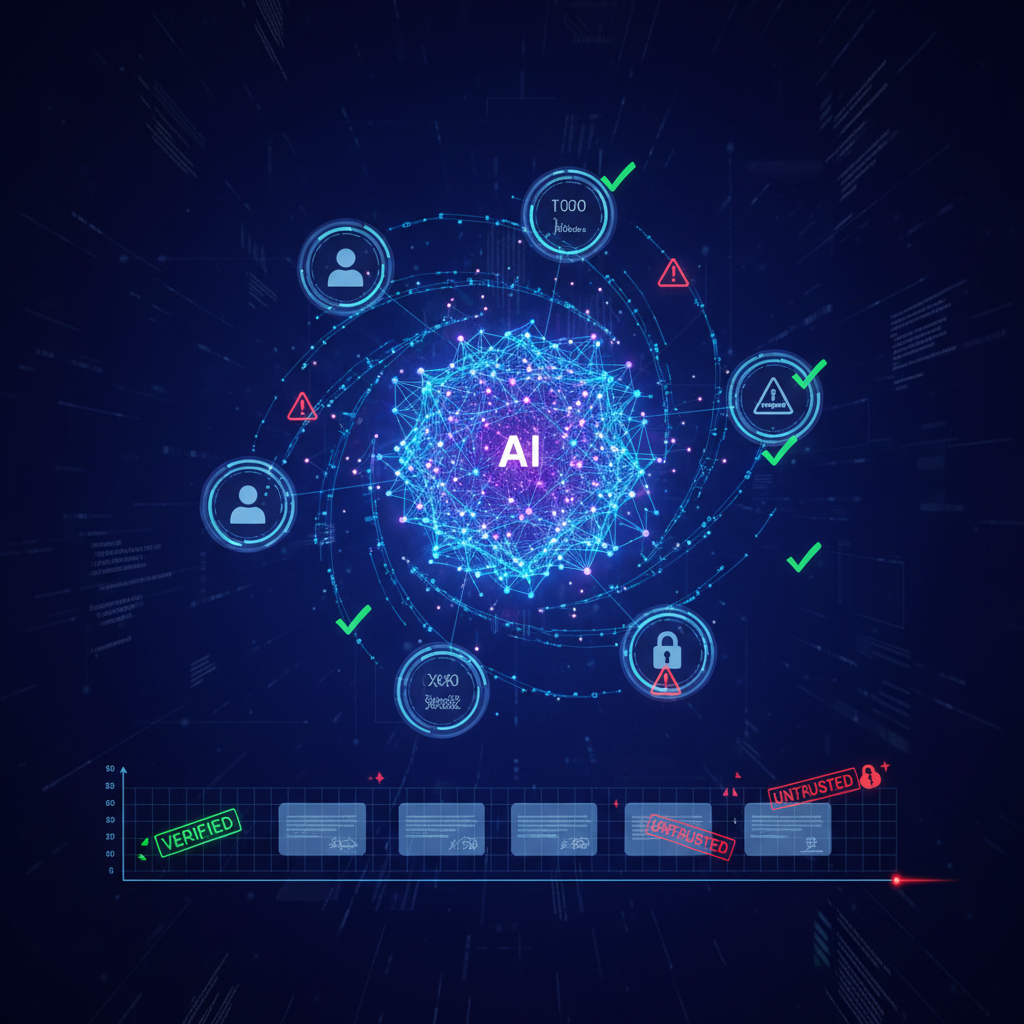
The rise of autonomous AI agents has fundamentally shifted the security paradigm. Unlike traditional applications that operate within predefined boundaries, AI agents make decisions at runtime, often with access to sensitive systems and data. This capability creates an entirely new attack surface that existing non-human identity (NHI) frameworks were never designed to address.
The core problem is visibility. When an AI agent executes, it does so with whatever permissions it inherits from its service account, API key, or other machine identity. But unlike human users, agents operate continuously, make autonomous decisions, and can escalate privileges or move laterally without any human gating. A single misconfigured token can give an agent unlimited access to production databases, payment systems, or customer records. And because agents operate at machine speed, the damage occurs in milliseconds—far faster than any alert or human response.
This is where runtime control becomes critical. Rather than relying solely on static access control lists, organizations need to implement continuous identity verification and behavioral monitoring for their agents. This means enforcing what we might call “just-in-time” identity assertions—agents should be required to prove their legitimacy not just at startup, but throughout their execution lifecycle. When an agent attempts an action that deviates from its expected behavior pattern, the system should challenge it in real time.
The second layer is context-aware access. Machine identities need to carry richer semantic information about their intended purpose, execution environment, and permissible actions. An agent orchestrating cloud deployments should have a fundamentally different security posture than one processing customer support tickets. Runtime control systems should evaluate each action against these contextual constraints, not just broad role-based access control.
Think of it this way: legacy NHI governance assumes a machine identity is either “trusted” or “untrusted” at provisioning time. Runtime control recognizes that trust is not binary—it’s continuous, contextual, and verifiable. As AI agents proliferate across enterprise systems, this shift from static to dynamic identity governance isn’t optional. It’s the difference between a controlled deployment and a privilege explosion waiting to happen.
Source: SC Media