
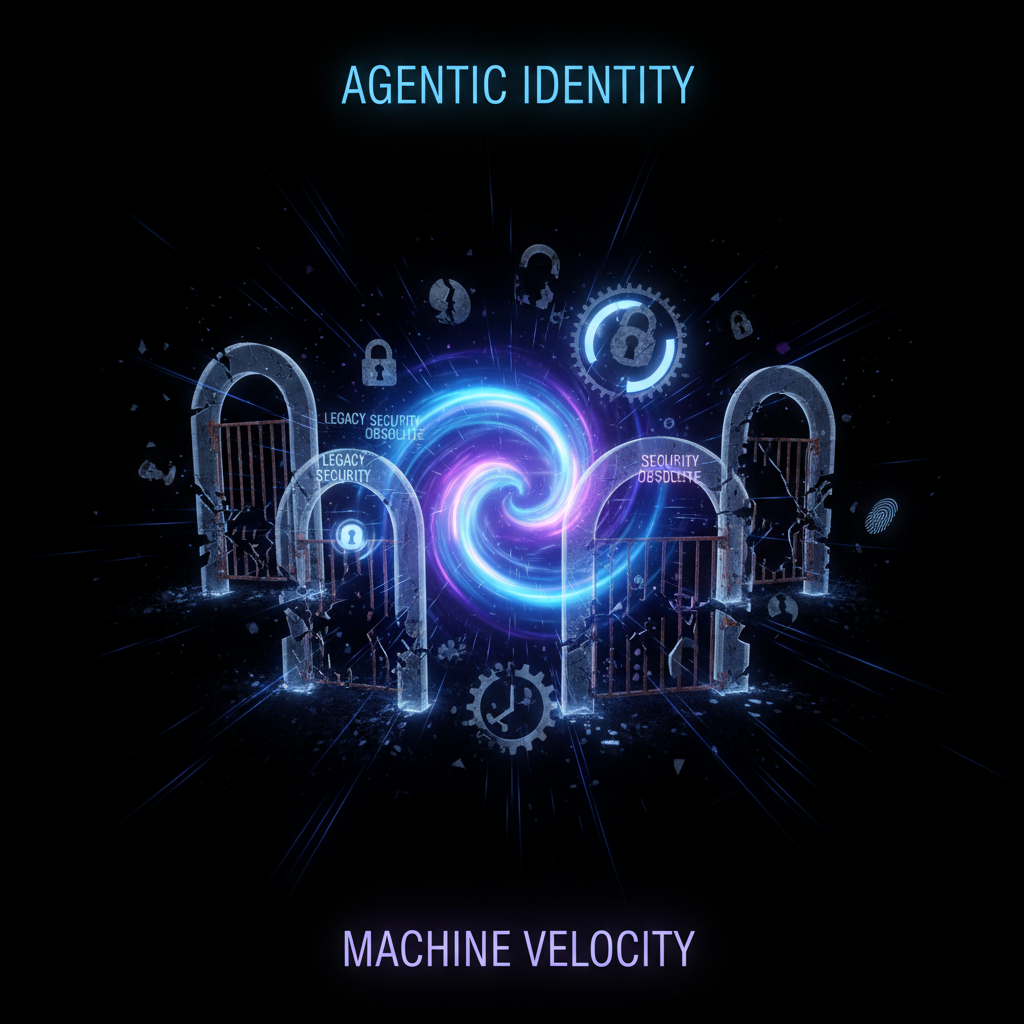
The security industrys definition of “continuous operation” is about to change. For decades, infrastructure teams measured uptime in nines — 99.9% availability meant acceptable risk. But with the rise of AI agents operating at machine speed, “continuous” no longer means days or hours between security checks. It means millisecond-by-millisecond activity, with identity events cascading at velocities that human monitoring cannot track.
This is not a minor technical adjustment to existing security frameworks. It is a categorical shift in what “authorization” and “identity governance” actually mean when the actor is not a human user with predictable patterns, but a software agent making millions of decisions per second.
The Scale Problem is Invisible Until Its a Crisis
A human user might authenticate once, perform some actions, log out. They leave an audit trail: one login, one action, one logout. An AI agent deployed to orchestrate a business process leaves a tsunami of telemetry. In a single minute, a machine identity might: call fifteen different APIs, spin up five transient containers, request credentials for six databases, create twelve temporary tokens, and revoke four expired keys. Traditional SIEM systems and log aggregators were built assuming human-scale event volumes. They will break under machine identity at scale.
More critically, the sheer volume of activity obscures the signal. If an AI agent is compromised and begins exfiltrating data, that malicious activity is mixed into millions of legitimate machine identity events. The signal-to-noise ratio is so poor that detection becomes probabilistic rather than certain. This is the invisibility problem: you cannot defend what you cannot see, and current monitoring approaches simply cannot surface the relevant activity.
Machine Speed Exposes Authorization Model Failures
Authorization models designed for humans assume a synchronous, interactive flow: user requests access, system evaluates policy, system grants or denies. This works fine when there are seconds or minutes between requests. But when an AI agent needs a decision every millisecond, the latency of traditional authorization models becomes untenable. The overhead of consulting a centralized policy engine, checking attribute-based access control rules, and validating context becomes a bottleneck.
The result is that organizations deploying AI agents often bypass security controls entirely — issuing broad, long-lived credentials that can be used for any purpose, rather than implementing fine-grained, ephemeral permissions. They trade security for performance, often without realizing theyve made that trade.
Continuous Operation Demands Continuous Verification
The only way to secure machine identity at scale is to abandon the model of occasional authentication checks and move to continuous verification. This means every single API call from an AI agent should be evaluated against current policy, validated against current identity state, and logged in a format that allows for rapid signal extraction. It means implementing cryptographic proof of identity rather than static credentials, so that compromised agents can be revoked instantly without waiting for key rotation.
It means building infrastructure that can make authorization decisions at machine speed — policy decisions rendered in microseconds — without the round-trip latency of external services. And it requires observability that can surface the relevant identity activity from the noise, highlighting anomalies and policy violations in real-time rather than in forensic logs reviewed days later.
AI agents operating at machine speed are not a faster version of human-driven IAM. They are a fundamentally different security domain, requiring new architectures, new authorization models, and new approaches to identity governance.
Source: Biometric Update