
Uber’s perspective on AI agent identity management distills a critical problem facing enterprises today: as organizations deploy more autonomous agents—from data processing pipelines to customer-facing bots—they’re discovering that traditional identity models fundamentally don’t fit. The “identity crisis” isn’t philosophical; it’s operational. Agents need identities that can be provisioned dynamically, revoked instantly, and monitored continuously. Today’s machine identity infrastructure was built for stable, long-lived service accounts. It breaks under the velocity and scale of agentic AI.
The core issue centers on trust boundaries. Human identities operate within organizational boundaries, approval workflows, and compliance frameworks. Machine identities, historically, served specific applications or microservices. But AI agents are different—they’re autonomous executors that need variable scopes of access depending on the task at hand. An agent processing customer support requests has different security requirements than one orchestrating infrastructure deployments. Yet most enterprises assign agents to static service accounts with fixed, broad permissions.
This creates the attack surface. If an agent’s service account is compromised or misconfigured, the damage potential is enormous. Unlike a human with granular access, an agent with overprivileged credentials can move laterally at machine speed, accessing systems it has no business touching. The identity crisis deepens when you consider how agents interact with each other—agents spawning sub-agents, delegation chains becoming opaque, accountability eroding as identities proliferate.
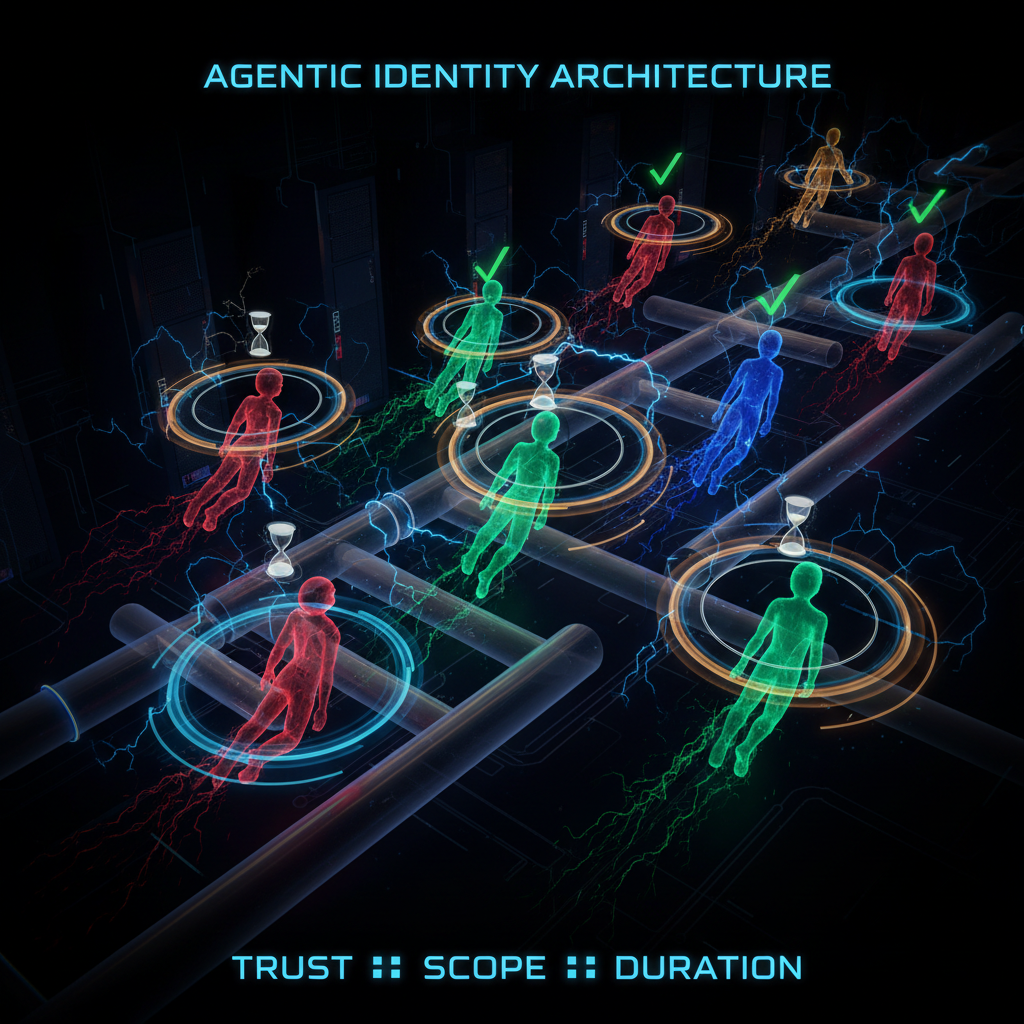
Solving this requires rethinking identity architecture for agentic workloads. First: short-lived credentials. Rather than long-lived API keys or service account tokens, agents should assume temporary, task-scoped identities that expire automatically. Second: context-aware scoping. The system should enforce what an agent can access based on its declared purpose and current execution environment, not just its static role. Third: continuous verification. Every API call, system access, or resource interaction should be validated against the agent’s current entitlements in real time.
The identity crisis for AI agents isn’t unsolvable—but it does require fundamentally rethinking how enterprises distribute and verify machine identity. This isn’t an identity governance problem alone; it’s an architecture problem that spans provisioning, runtime control, and forensics.
Source: Uber